
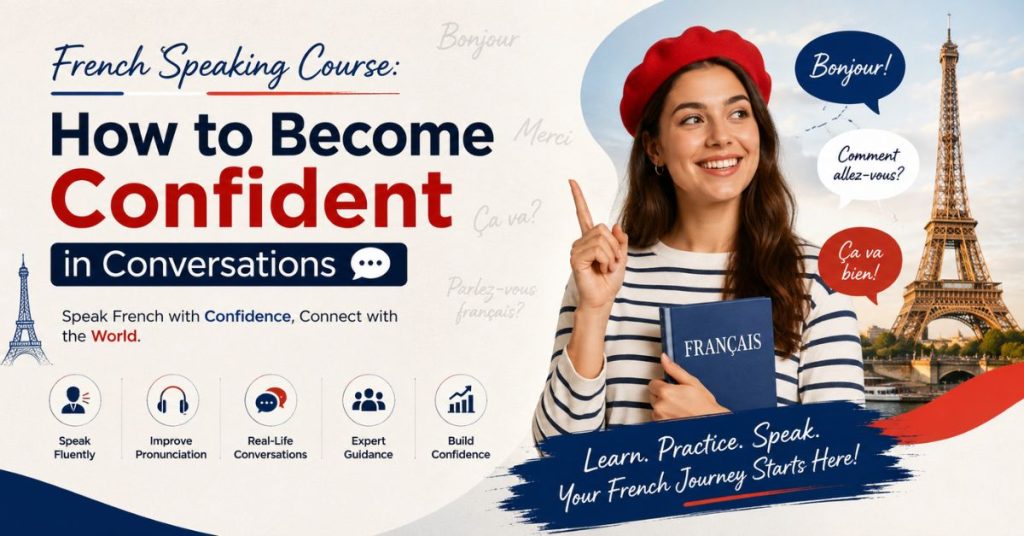
Many people spend months studying French vocabulary and grammar, yet freeze the moment they need to actually say something. If that sounds familiar, you are not alone. The gap between “knowing” French and “speaking” French trips up learners at every level.
The usual culprits are easy to recognise: fear of making mistakes, translating every sentence from English before speaking, pronunciation that feels shaky, a vocabulary that works fine on paper but disappears in conversation, and simply not getting enough chances to talk. Grammar drills and vocabulary lists help you understand the language, but they rarely build the reflex of speaking it in real time.
That reflex comes from active speaking practice structured, repeated, and guided. This is exactly the gap a French Speaking Course is designed to close. At Eiffel Institute of French – French Classes by Ankita Wadhwani, the focus stays on helping learners move from understanding French to actually using it in conversation.
Why Is Speaking French Difficult for Beginners?
Fear of Making Mistakes
Most learners hold back because they are afraid of sounding wrong in front of others. But mistakes are simply part of how any language gets learned every fluent speaker made hundreds of them along the way. Treating errors as feedback rather than failure is often the first mental shift that unlocks progress.
Translating Before Speaking
When you mentally translate each sentence from English to French before saying it, conversation becomes slow and exhausting. Real fluency depends on learning to form simple French sentences directly, without the detour through English.
Limited Vocabulary
Many learners memorise long, random word lists that rarely show up in actual conversations. It is far more useful to learn practical phrases and expressions tied to real situations greetings, questions, everyday responses rather than isolated vocabulary.
French Pronunciation
French has sounds that don’t exist in English, and getting them slightly wrong can make learners self-conscious about speaking out loud. Regular listening and repetition gradually make pronunciation feel natural instead of intimidating.
Lack of Conversation Practice
Reading and writing French can build strong comprehension, but they don’t train the specific skill of speaking. Without regular spoken practice, even learners with good grammar knowledge often struggle to hold a conversation.
How to Start Speaking French as a Beginner
If you are just starting out, a simple, structured approach works better than trying to learn everything at once.
- Learn basic greetings.
- Learn how to introduce yourself.
- Practice common questions you’ll hear often.
- Memorise a handful of useful conversational phrases.
- Speak short sentences every day, even if they’re simple.
- Listen to French audio and repeat what you hear.
- Practice simple role-play situations, like ordering coffee.
- Gradually increase how long your conversations run.
A few examples to get started:
Bonjour ! — Hello!
Comment allez-vous ? — How are you?
Je m’appelle… — My name is…
J’habite à… — I live in…
Qu’est-ce que vous faites ? — What do you do?
You don’t need dozens of phrases to begin — a small set, practiced consistently, takes you further than a long list you never use.
What Is a French Speaking Course?
A French Speaking Course is designed specifically around building the ability to speak and understand French in real conversations, rather than focusing mainly on grammar rules and written exercises.
It typically combines:
- Speaking practice
- Listening
- Pronunciation
- Vocabulary tied to real situations
- Sentence formation
- Conversation exercises
- Real-life scenarios
- Instructor feedback
The exact curriculum will vary from one institute to another, and it should also adapt to the learner’s current level — a complete beginner and someone with intermediate French need different kinds of practice.
What Do You Learn in a French Speaking Course?
Everyday Conversations
Greetings, introductions, talking about family, hobbies, your daily routine, and expressing likes and dislikes — the vocabulary you’d use in casual, everyday exchanges.
Travel Conversations
Practical language for the airport, hotel check-ins, ordering at a restaurant, using transportation, and asking for directions.
Social Conversations
How to meet new people, ask questions naturally, make plans, and express opinions in a conversation.
Professional Conversations
Introducing yourself in a work context, talking about your job, workplace communication, and handling basic professional interactions in French.
French Conversation Practice: 10 Exercises That Build Confidence
- Mirror speaking — Speak French sentences aloud in front of a mirror to get comfortable hearing your own voice in the language.
- Self-introduction practice — Rehearse introducing yourself until it feels automatic, since this comes up in almost every conversation.
- Question-and-answer drills — Practice answering common questions quickly to build faster reaction time.
- Shadowing French audio — Repeat along with native audio, matching rhythm and pronunciation as closely as possible.
- Role-play conversations — Act out situations like ordering food or asking for directions to practice functional, real-world French.
- Voice recording — Record yourself speaking and listen back to catch pronunciation habits you might not notice in the moment.
- Describe your surroundings — Narrate what you see around you in simple French to build spontaneous sentence formation.
- Think in simple French — Try forming basic thoughts directly in French instead of translating from English.
- Practice with a speaking partner — Regular conversation with another learner or speaker builds real-time responsiveness.
- Daily 10–15 minute French speaking sessions — Short, consistent practice compounds faster than occasional long sessions.
Each of these targets a different part of the speaking skill — pronunciation, reaction time, vocabulary recall, or sentence formation — so combining a few of them tends to work better than relying on just one.
How to Overcome Fear of Speaking French
- Stop trying to speak perfectly — aim to communicate first.
- Start with short, simple sentences rather than complex ones.
- Focus on getting your message across, not on sounding flawless.
- Practice regularly, even in small amounts.
- Accept corrections as part of learning, not criticism.
- Repeat phrases you find difficult until they feel natural.
- Celebrate small improvements instead of only measuring how far you have to go.
Confidence in speaking French tends to come from repeated practice, not from waiting until your French feels “ready.”
French Speaking Course 2026: What Should You Look For?
If you’re evaluating a French Speaking Course in 2026, a few practical factors matter more than the year on the brochure:
- A curriculum that is genuinely speaking-focused, not just grammar-heavy
- Practical conversation activities built into the sessions
- An experienced instructor who can guide pronunciation and usage
- Regular feedback on your speaking, not just written tests
- Teaching that is beginner-friendly if you’re starting from zero
- Flexible scheduling that fits around your routine
- Availability of online learning if that suits you better
- Clearly defined course levels so you know what you’re progressing toward
- Small-group or interactive practice rather than passive lectures
- Some way to track your progress over time
French Speaking Course Online: Is Online Learning Effective?
An online French Speaking Course can work well, provided the format includes real interaction rather than one-way video lessons. Look for:
- Live instructor interaction, not just pre-recorded content
- Speaking practice through video sessions
- Flexible learning schedules that work around your day
- Online assignments to reinforce what you’ve practiced
- Digital resources for vocabulary and grammar reference
- Listening activities to train your ear
- Remote conversation practice with the instructor or other learners
The effectiveness of an online course depends heavily on interaction, consistency, and how much actual speaking practice is built in — not simply on the fact that it’s delivered online. A well-structured online course can be just as effective as an in-person one for building speaking confidence.
French Speaking Course in Udaipur: How to Choose the Right Course
If you’re looking for a French Speaking Course in Udaipur, it helps to check a few things before enrolling:
- The instructor’s teaching approach
- Whether the course syllabus is clearly laid out
- Availability of beginner-to-advanced levels
- How much actual speaking practice is included
- Class size, which affects how much individual attention you get
- Course duration and pacing
- Whether online or offline (or both) options are available
- Whether there’s a system for feedback on your progress
- What learning resources are provided
- Whether a demo or trial class is available before you commit
Eiffel Institute of French – French Classes by Ankita Wadhwani offers structured French learning for those in Udaipur looking for guided, conversation-focused classes. As with any course, it’s worth checking the specific format, schedule, and levels offered to see if it matches what you’re looking for.
French Speaking Course vs Learning French on Your Own
| Factor | French Speaking Course | Self-Learning |
| Structured curriculum | Guided | Self-managed |
| Speaking practice | Planned | Depends on learner |
| Instructor feedback | Available | Limited |
| Pronunciation correction | Guided | Difficult to assess |
| Accountability | Higher | Self-dependent |
| Flexibility | Depends on course | High |
| Conversation practice | Structured | Must be arranged |
Neither approach is universally “better.” A structured course offers guidance, feedback, and built-in speaking practice, which many beginners find hard to replicate alone. Self-learning offers more flexibility but demands more discipline to find speaking opportunities and check your own pronunciation. Some learners even combine both — using a course for structure and self-study to reinforce it between sessions.
How Long Does It Take to Speak French Confidently?
There’s no fixed timeline for this, and claims like “become fluent in 30 days” don’t reflect how language learning actually works. How quickly you progress depends on:
- Your starting level
- How often you practice
- How much daily exposure you get to French
- How many real speaking opportunities you have
- The structure of your course, if you’re taking one
- Your own learning pace
It also helps to separate two different goals. Basic conversational ability — enough to handle greetings, simple questions, and everyday exchanges — can develop with consistent practice over a matter of months. Advanced fluency, where you can discuss complex topics comfortably, takes sustained practice over a much longer period. Knowing which one you’re aiming for helps you set realistic expectations.
Who Should Join a French Speaking Course?
A French Speaking Course can be useful for a wide range of learners, including:
- Complete beginners
- Students
- Working professionals
- Travelers
- Study-abroad aspirants
- People preparing for French exams
- Anyone planning to work in a French-speaking environment
- Learners who understand French but struggle to speak it
- Anyone who wants structured, guided conversation practice
Why Choose Eiffel Institute of French – French Classes by Ankita Wadhwani?
Learning to speak French confidently is easier with structured classes and guided practice, rather than trying to piece it together on your own. At Eiffel Institute of French, the focus stays on:
- Building genuine speaking confidence, not just theoretical knowledge
- Developing practical conversation skills you can actually use
- Consistent, regular practice rather than one-off sessions
- Learning step-by-step, matched to your current level
- Getting guidance as you improve, rather than learning in isolation
Frequently Asked Questions
What is a French Speaking Course?
A French Speaking Course is a program focused on building your ability to speak and understand French in real conversations, combining speaking practice, listening, pronunciation, and instructor feedback rather than concentrating only on grammar and writing.
Is a French Speaking Course suitable for complete beginners?
Yes. Most French Speaking Courses are structured to accommodate different levels, including complete beginners, starting with basic greetings and simple sentence patterns before building up to fuller conversations.
How can I become confident speaking French?
Confidence builds through regular, active speaking practice — short daily sessions, exercises like shadowing and role-play, and accepting mistakes as a normal part of the process rather than waiting until your French feels perfect.
Can I take a French Speaking Course Online?
Yes, as long as the course includes live interaction and real speaking practice rather than only pre-recorded lessons. A well-structured online course can build speaking confidence effectively.
What should I look for in a French Speaking Course in Udaipur?
Check the instructor’s teaching approach, course syllabus, class size, available levels, speaking practice included, and whether a demo class is offered before you enroll.
How long does it take to speak French confidently?
There’s no fixed timeline — it depends on your starting level, practice frequency, and exposure. Basic conversational ability can develop over months of consistent practice, while advanced fluency takes considerably longer.
How can I practice French conversation every day?
Short daily habits work well: speaking simple sentences aloud, shadowing audio, describing your surroundings in French, and practicing with a speaking partner for even 10–15 minutes a day.
Is conversational French different from learning French grammar?
Yes. Grammar builds your understanding of how the language works, while conversational French is about applying that knowledge in real time — a skill that needs active speaking practice, not just study. If you’re looking for structured guidance and regular conversation practice, you can explore the French learning options at Eiffel Institute of French – French Classes by Ankita Wadhwani and choose a course based on your current level and learning goals.