
If you are planning a Canadian immigration application, you have probably heard that French can strengthen your profile. That is true for some applicants, but not for everyone. French is not compulsory for every Canada PR pathway, and the right French classes for Canada PR depend on your current level, your target score and the route you are applying through.
This guide explains where French fits into Express Entry, how TEF Canada and TCF Canada differ, what level you actually need, and what to look for before you enrol in a course.
Can Learning French Help with Canada PR?
It can, but a French course does not give you any immigration benefit by itself. What counts is your result in an approved test. Four separate things are often mixed up:
- Program eligibility: you must first qualify for an Express Entry program (Federal Skilled Worker, Federal Skilled Trades or Canadian Experience Class). Each has its own language minimum.
- French-language category invitations: IRCC runs category-based rounds for candidates in the Express Entry pool who meet the French-language proficiency category criteria. These are invitation rounds, not a separate visa.
- CRS points: French test results can add points to your Comprehensive Ranking System score, either as a first or second official language or through additional points for strong French. The additional-points rules have been under review by IRCC, so check the current CRS criteria before you plan around them.
- The final decision: an invitation is not an approval. IRCC decides on the full application, including admissibility and the accuracy of your profile.
No institute can promise an invitation, a CRS outcome or PR approval, and you should be wary of any course that does.
TEF Canada vs TCF Canada: Which Test Should You Choose?
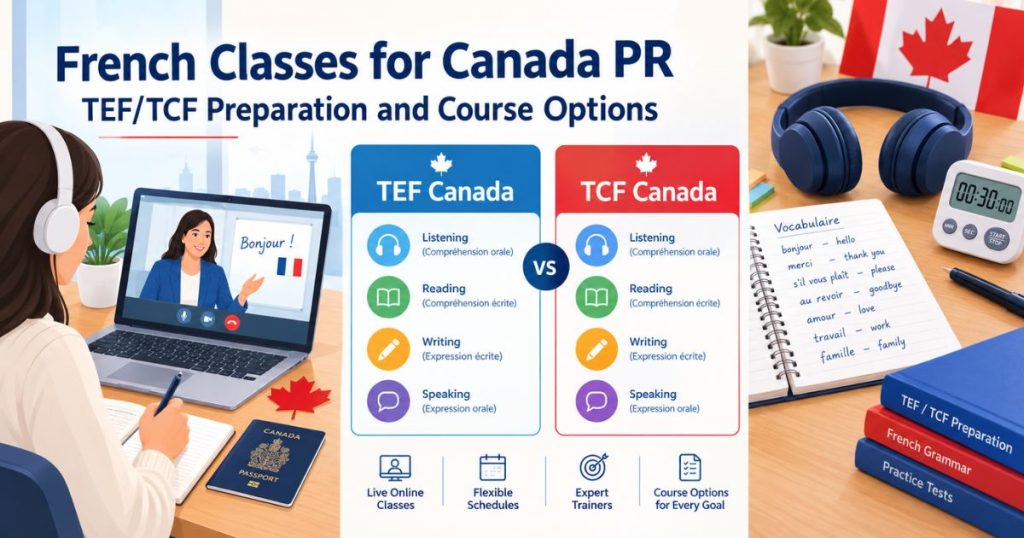
IRCC accepts two French tests for Express Entry: TEF Canada and TCF Canada. Neither is officially easier or better. The choice usually comes down to test format, availability near you and which one you feel more comfortable practising.
| TEF Canada | TCF Canada | |
|---|---|---|
| Purpose | Approved French test for Express Entry | Approved French test for Express Entry |
| Skills tested | Listening, reading, writing, speaking | Listening, reading, writing, speaking |
| Score reporting | Per-skill scores; IRCC tells you to use the “Équivalence ancien score” column, not the “Score / 699” column | Per-skill scores; listening and reading are reported on a numeric scale, speaking and writing on a short 0–20 scale |
| Preparation focus | Practise each section against the score bands IRCC converts to NCLC | Practise each section against the score bands IRCC converts to NCLC |
| Official acceptance | Accepted by IRCC, subject to current rules | Accepted by IRCC, subject to current rules |
Before booking, check IRCC’s language-test page for the correct score column and conversion tables. Entering the wrong figures in your profile can lead to a refused application. Also note that test results must be less than two years old when you complete your profile and when you apply.
What French Proficiency Level Is Needed for Canada PR?
Canada measures French with the Niveaux de compétence linguistique canadiens (NCLC). The level you need depends on the program:
- French-language proficiency category: at least NCLC 7 in all four abilities (speaking, listening, reading, writing), plus the other eligibility requirements for the round.
- Federal Skilled Worker (French as first language): NCLC 7 in all four abilities.
- Canadian Experience Class: NCLC 7 for TEER 0 or 1 jobs, NCLC 5 for TEER 2 or 3 jobs.
- Federal Skilled Trades: NCLC 5 for speaking and listening, NCLC 4 for reading and writing.
There is no averaging across skills for the category, so a strong speaking score does not make up for a weak writing score.
One common confusion: CEFR levels (A1, A2, B1, B2) and NCLC levels are different scales. They may feel similar in everyday conversation, but they are not officially interchangeable, and a course level or certificate is not a substitute for your test result. Language-learning levels tell you what you are studying; NCLC tells IRCC what you scored.
How to Choose French Classes for Canada PR
A good course for immigration goals should let you check these points:
- A clear path from your level upward. If you are a beginner, the course should show how you move from basics toward the level your pathway needs.
- Dedicated TEF Canada or TCF Canada preparation. A general French course builds the language, but it does not automatically cover test format, timing and scoring. Ask directly.
- Speaking and listening practice. Both are tested, and both are hard to improve alone.
- Feedback on writing and reading. Corrections matter more than volume of homework.
- Practice assessments, if offered, and how results are explained to you.
- Teacher guidance, batch timings and course fees that fit your situation.
At French Classes by Ankita Wadhwani / Eiffel Language Institute, the published course pages list CEFR-based levels from A1 to B2 in online and offline formats, with weekday batches (one hour a day, five days a week) and weekend batches for working professionals. You can see the details on the online French courses page. The institute also notes that exam-preparation courses are available on enquiry, so ask which exam preparation is currently offered.
Can Beginners Start Learning French for Canada PR?
Yes. Many applicants start from zero. Beginners first build vocabulary, pronunciation, basic grammar and the habit of speaking, then move toward the higher level their pathway requires, and finally add test-specific practice.
Be realistic about the gap. Moving from beginner to the NCLC 7 range is a long-term goal, not a short course. Your starting point, your study hours and the quality of feedback you get will shape how far you travel and how fast. A plan that sounds too quick usually is.
How Long Does It Take to Prepare for TEF Canada or TCF Canada?
No honest answer fits everyone. Your timeline depends on:
- your starting level and your target NCLC benchmark,
- how many hours you study each week, and how consistently,
- how much speaking and writing feedback you receive,
- how much time you spend on timed, test-style practice.
Learning French and preparing for a test score are two different jobs. You can be comfortable in conversation and still lose marks to timing, format or writing structure. To understand typical progression across levels, see this guide to French learning levels and course duration, and treat any three-month or six-month promise to reach NCLC 7 with caution.
Online French Classes vs Self-Study for Immigration Preparation
| Live online classes | Recorded lessons | Self-study | |
|---|---|---|---|
| Flexibility | Fixed batch timings, often with options | Study anytime | Fully flexible |
| Speaking practice | Real-time with a teacher | Limited | Hard to get alone |
| Feedback | Direct and immediate | Usually delayed or absent | Depends on you finding it |
| Structure | Planned progression | Planned, but self-paced | You design it |
| Accountability | High | Medium | Low |
For most applicants, live classes plus regular self-study is the most balanced option: the class provides structure, speaking practice and correction, and self-study fills in vocabulary and listening hours. Recordings and apps are useful supplements, but speaking and writing are the skills where unguided learners most often stall.
How to Enquire About the Right French Course
Before paying for any course, ask these questions:
- Which level will I start at, and how is that decided?
- Is there dedicated TEF Canada or TCF Canada preparation, or is this a general French course?
- Which proficiency levels does the course cover?
- What are the batch timings (weekday or weekend), and is the class online or offline?
- How much live speaking and listening practice is included?
- How is writing corrected and how often?
- Are practice assessments included?
- What are the fees, and what do they include?
If you are planning French for Canadian immigration, the simplest next step is to speak with the institute about your current level and goal. Contact French Classes by Ankita Wadhwani through the Contact page or call +91-7877771361 to get guidance on a suitable course. You can also review French course fees in India to understand how pricing varies by level and format.
Frequently Asked Questions
1. Are French classes required for Canada PR? No. Many PR routes need only English. French is optional but can help in some Express Entry situations.
2. Can French proficiency improve Express Entry opportunities? It can. French test results may add CRS points and may make you eligible for French-language category rounds. Rules change, so check IRCC before planning.
3. Which is better for Canada PR: TEF Canada or TCF Canada? Neither is universally better. IRCC accepts both. Choose based on format, availability and your comfort with practice material.
4. Can beginners learn French online for Canadian immigration? Yes, starting from A1 is common. Expect a gradual path from fundamentals to test-level skills, with no guaranteed timeline.
5. Does a French course completion certificate replace TEF Canada or TCF Canada results? No. IRCC requires results from an approved test. A course certificate shows you studied; it is not a test result.
6. How long does it take to prepare for a French proficiency test? It depends on your starting level, target NCLC, weekly study hours and feedback. Be cautious of fixed promises.
7. What NCLC level is required for the French-language proficiency category?
At least NCLC 7 in speaking, listening, reading and writing, along with the other requirements for the round.
8. Where can applicants verify the latest immigration language requirements?
On IRCC’s official Express Entry pages for language tests and category-based selection (see sources below). Requirements and rounds can change.