Why French Matters for Indian Businesses Today
Many Indian companies now work with clients, partners and teams in France, Belgium, Switzerland, Canada, and across francophone Africa. Some of these relationships start with a single email, and the first few exchanges often decide whether a business deal moves forward. When employees can communicate in French, even at a basic professional level, clients notice the effort and trust tends to build faster.
Corporate French training is a structured way for companies to build this capability across a team. Instead of relying on one or two multilingual employees, a business can develop French skills across departments, from sales and customer support to operations and management. For HR and learning and development teams, it is a practical investment in communication and career growth.
This guide explains what corporate French training involves, which programs companies can choose from, how long learning typically takes, how online and offline formats compare, and how to select the right training partner.
What Is Corporate French Training?
Corporate French training is a group or team-based language program designed for working professionals. It differs from individual French classes in several ways. The curriculum is usually built around workplace situations such as client calls, meetings, emails and presentations. Batches are often formed by company, department or proficiency level. The company may also want progress reports, attendance tracking and assessments so it can measure how the program is working.
Companies typically arrange corporate French training in one of three ways. They may enroll a group of employees in a dedicated batch, sign up individuals for a flexible group schedule, or request a customized program for a specific team with its own goals. The right model depends on how many people need training, their current level, and how quickly the business needs results.
Why Do Indian Companies Need French Language Training for Employees?
The reasons vary by industry, but several themes come up often.
- Better communication with French-speaking clients. Employees who can greet a client, confirm a meeting or follow a conversation in French reduce misunderstandings and show respect for the client’s language.
- International business expansion. Companies entering French-speaking markets often find that local language skills help with negotiations, documentation and day-to-day coordination.
- Stronger customer support. Support teams serving French-speaking customers can resolve queries more smoothly when they understand the customer directly.
- Employee development and career growth. Language skills are a visible addition to a professional profile and can open doors to new roles.
- Preparation for overseas assignments. Employees heading to France, Canada or other francophone regions adjust faster when they already have working French.
- Collaboration with international teams. Mixed-language teams work better when members share a common professional language.
Corporate French Training Programs Available for Companies
Corporate programs are usually organized by the CEFR scale, the Common European Framework of Reference for Languages, which describes proficiency from A1 (beginner) to C2 (mastery). Most workplace programs focus on levels A1 to B2, with business French added as a specialized track.
Beginner French Training (A1): Employees learn basic greetings, introductions, simple questions and answers, and everyday phrases. This level suits teams that need a foundation, such as front-desk staff or new hires who will have occasional French contact.
Elementary French Training (A2): Learners can handle routine exchanges, describe their work in simple terms, write short messages and understand familiar workplace topics. This is a common starting point for customer support and coordination roles.
Intermediate French Training (B1): Employees can take part in most conversations on work-related topics, handle some client calls, and write clear emails on familiar subjects. This level suits sales, account management and operations staff.
Upper-Intermediate French Training (B2): Learners can communicate fluently and spontaneously in many professional situations, present ideas, and discuss complex topics. This level is often chosen by senior staff, client-facing leads and employees preparing for longer international assignments.
Business French and Professional Communication: This track focuses on vocabulary and conventions used in meetings, negotiations, proposals and formal correspondence. It can be combined with any level above, and it works well for managers, consultants and export teams.
What Is Included in a Corporate French Training Program?
A well-structured corporate program usually covers the following areas.
- Speaking and pronunciation: Regular speaking practice is the core of most workplace programs, since confidence in conversation is often the main goal.
- Business vocabulary: Learners build word lists tied to their industry, whether that is IT, hospitality, logistics or finance.
- Reading and writing: Participants practice reading emails, reports and documents, and writing short professional messages.
- Listening comprehension: Exercises use audio from realistic workplace situations.
- Professional email communication: Learners practice formal and informal emails, including greetings, requests, follow-ups and polite refusals.
- Client conversations and meetings: Practice scenarios cover introductions, scheduling, handling questions and closing a discussion.
- Practical role-play activities: Simulated calls and meetings help employees apply what they have learned in a low-pressure setting.
- Assessments and progress tracking: Periodic checks show how each learner is progressing, which helps HR teams measure results.
Specific components, session formats and assessment methods should be confirmed for each program before enrolling, since they can differ by course.
How Long Does Corporate French Training Take?
Learning timelines depend on several factors: the employee’s starting level, their target level, how many sessions they attend each week, how much they practice between classes, and how much exposure they get to French at work. An employee who already knows some French will generally progress faster than a complete beginner.
The table below gives a general guide to how the levels are typically approached in corporate settings. Actual duration depends on the training schedule, learning pace and course structure, and these estimates are not guaranteed results.
| Training Level | Learning Objective | Estimated Duration | Suitable Employees |
|---|---|---|---|
| A1 Beginner | Basic greetings and everyday phrases | [Confirm course hours] | New hires, front-desk and support staff |
| A2 Elementary | Routine workplace exchanges and short messages | [Confirm course hours] | Customer support, coordination roles |
| B1 Intermediate | Work conversations, client calls, clear emails | [Confirm course hours] | Sales, account management, operations |
| B2 Upper-Intermediate | Fluent professional communication and presentations | [Confirm course hours] | Senior staff, client leads, overseas candidates |
| Business French | Meetings, negotiations, formal correspondence | [Confirm course hours] | Managers, consultants, export teams |
Companies should ask for a training plan that states the expected hours and class frequency for each level, so they can plan around employee schedules.
Online vs Offline Corporate French Training
Both formats have a place in corporate learning, and the choice depends on the company’s location, team size and preferences.
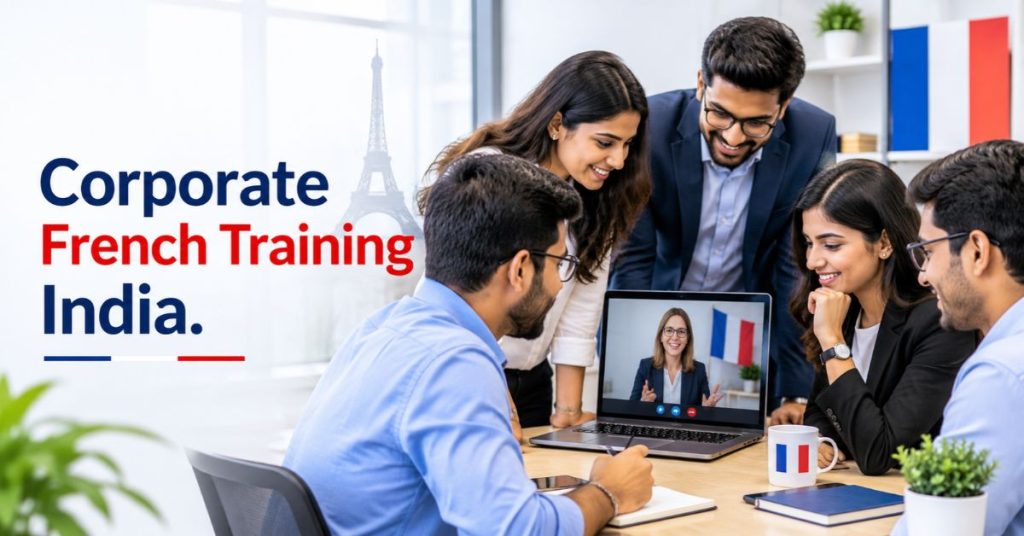
Online live instructor-led classes allow employees to join from their office, home or another city while still speaking with a trainer and classmates in real time. This is useful for companies with staff spread across several cities or for teams that cannot easily leave their desks.
Offline classroom training suits companies with a central office and employees who prefer in-person learning. It can offer a more immersive atmosphere but requires room booking, travel time and coordination.
Flexible group training brings together employees from different companies or departments in shared batches. It is often more affordable and suits smaller teams.
Dedicated corporate batches are formed only for one company. Timings, content and pace can be aligned with the company’s needs, which helps when a team has shared goals or a specific deadline.
For companies with employees across multiple cities, online training offers a practical advantage: one trainer and one curriculum can serve everyone, without the cost and delay of setting up classrooms in each location.
Industries That Benefit from Corporate French Training
French language skills create value across many sectors. Here are some practical examples.
- IT and ITES: Developers and support engineers working with French clients can understand requirements, join client calls and document issues more clearly.
- BPO and Customer Support: Agents handling French-speaking customers can resolve queries faster and reduce escalations.
- Hospitality and Tourism: Hotel and travel staff can welcome French-speaking guests, answer questions and handle bookings in their language.
- Aviation: Ground staff and cabin-facing teams serving French-speaking travelers benefit from basic and professional French communication.
- Banking and Financial Services: Relationship managers and advisors working with francophone clients can build trust through direct communication.
- International Trade and Export: Export teams corresponding with buyers in France, Belgium or West Africa can handle orders, quotations and follow-ups more efficiently.
- Consulting and Global Operations: Consultants and project managers coordinating with French offices can participate in meetings and contribute more effectively.
Benefits of Corporate French Training for Employers and Employees
For employers:
- Better communication with international clients and partners
- Stronger global business relationships built on mutual respect
- Improved workforce capabilities across departments
- Better support for international expansion and overseas projects
For employees:
- Development of a practical professional skill
- Greater confidence when speaking with clients or colleagues
- New international career opportunities
- Better readiness for global assignments
When both sides benefit, the training is easier to justify internally and easier to sustain over time.
How to Choose the Right Corporate French Training Partner in India
Selecting a training provider is an important decision. These factors help HR and L&D teams compare options.
- Qualified French trainers: Ask about the trainers’ teaching background and French proficiency.
- Structured course curriculum: A clear syllabus with defined levels and learning outcomes makes progress easier to track.
- Flexible batch timings: Look for options that fit around working hours, including early morning, evening or weekend batches.
- Customized corporate programs: The provider should be willing to tailor content to your industry and team goals.
- Practical, speaking-focused sessions: Workplace French depends on speaking confidence, so check how much time is spent on conversation.
- Regular assessments: Periodic evaluations show whether learners are improving.
- Progress reports: Written updates help managers and HR teams track results.
- Trial or demo sessions: A demo lets you judge the teaching style and format before committing a team.
Why Choose Eiffel Language Institute for Corporate French Training?
Eiffel Language Institute offers online instructor-led French classes designed for learners who want practical language skills. Companies interested in corporate programs can discuss their goals with the team to plan a suitable approach.
Key features of the training include:
- Online instructor-led French classes
- Structured learning programs
- Interactive learning sessions
- Flexible scheduling
- Customized learning objectives for teams
- Trainer guidance and assessments
[Verify before publishing: add any confirmed details such as batch sizes, trainer experience, or demo format.]
Frequently Asked Questions
What is corporate French training?
Corporate French training is a structured language program for working professionals. It focuses on the communication skills employees need for their jobs, such as client calls, meetings and professional emails.
Can companies arrange online French classes for employees in India?
Yes. Online live classes allow employees across different cities to attend the same program with a single trainer and curriculum. Companies can discuss scheduling and batch formation directly with the institute.
How long does it take employees to learn French?
It depends on the starting level, target level, class frequency and practice outside class. Employees with no prior knowledge typically need more time to reach professional fluency than those with some background. Ask for a timeline based on your specific program.
What French level is required for corporate employees?
There is no single requirement. Many companies start with A1 or A2 for general staff and B1 or B2 for client-facing or senior roles. A short assessment can help determine the right starting point for each employee.
Can corporate French training be customized for different departments?
Yes, customization is a common request. Sales, support, operations and management teams often need different vocabulary and scenarios, and programs can be adjusted to reflect these needs.
What is the cost of corporate French training in India?
Pricing depends on the number of participants, level, format and program length. Request a proposal for an accurate quote tailored to your team.
Are weekend or flexible batch timings available?
Flexible scheduling is an important part of corporate training. Ask the institute about available weekday, evening and weekend options for your team.
How can a company arrange a French training program for its employees?
Start by sharing the number of employees, their current French level, your desired outcomes and your preferred schedule. The institute can then propose a program, and you can request a demo session before finalizing.
Ready to Build a French Capability in Your Team?
Corporate French training works best when it is planned around your business goals. If your company is looking to improve client communication, support international expansion or prepare employees for overseas work, the next step is a conversation. HR managers and corporate decision-makers can contact Eiffel Language Institute to request a customized corporate French training plan.