

The DELF A1 (Diplôme d’Études en Langue Française) is an official qualification awarded by the French Ministry of Education, certifying your ability to communicate in French at the CEFR A1 level – the entry point for absolute beginners. It’s designed for anyone who needs a recognised, permanently valid certificate: students planning to study in France, professionals adding French to their resume, or learners simply starting their French journey with a structured goal in mind. This guide walks you through the exact exam structure, an official syllabus checklist, realistic study timelines, a week-by-week 8-week plan, and a daily practice routine – everything you need to prepare for DELF A1 with confidence.
What Is the DELF A1 Exam?
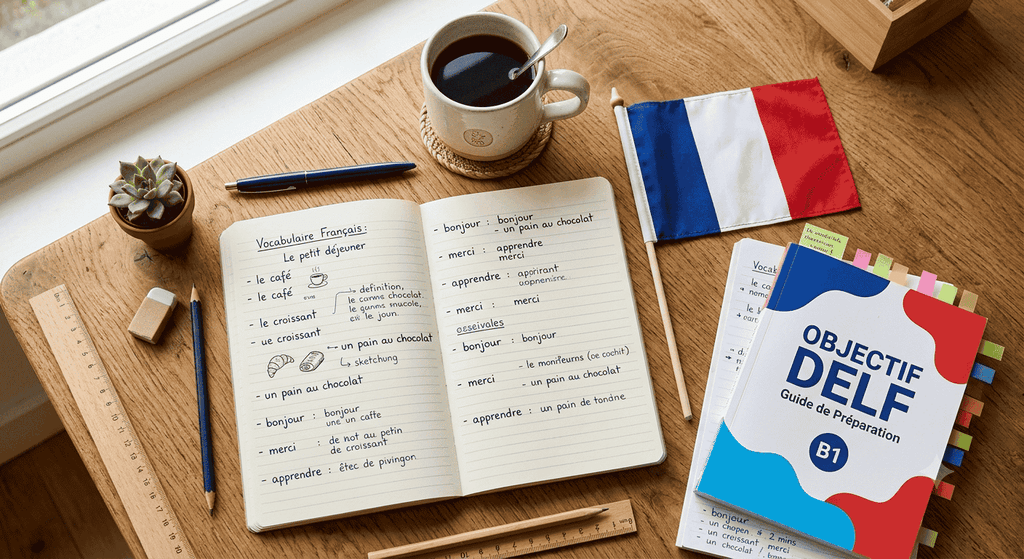
In short: DELF A1 is the first level of the official Diplôme d’Études en Langue Française, awarded by France’s Ministry of Education and aligned with CEFR level A1. It certifies basic communication skills – simple self-introductions, everyday requests, and recognition of common French words and phrases. The certificate never expires.
Unlike course-completion certificates issued by individual schools, DELF is a government-recognised diploma valid worldwide and for life – there’s no need to retake or renew it. At the A1 level, examiners expect you to handle very simple, predictable interactions: introducing yourself, asking someone’s name or where they live, filling in a basic form, and understanding short, clearly spoken sentences about familiar topics.
Official DELF A1 Exam Structure & Scoring Breakdown

In short: DELF A1 is scored out of 100 across four skills – listening, reading, writing, and speaking – each worth 25 points. You need a total of 50/100 to pass, with a minimum of 5/25 in every individual skill. Total exam time is roughly 1 hour 20 minutes of written tests plus a 5–7-minute oral test.
| Skill Section | Duration | Max Score | Min. Required Score | Task Type Overview |
| Compréhension de l’oral (Listening) | ~20 mins | 25 | 5 / 25 | Short audio recordings on everyday situations |
| Compréhension des écrits (Reading) | 30 mins | 25 | 5 / 25 | Simple texts, notices, postcards, advertisements |
| Production écrite (Writing) | 30 mins | 25 | 5 / 25 | Form filling, simple messages/postcards (40–50 words) |
| Production orale (Speaking) | 5–7 mins (+10 min prep) | 25 | 5 / 25 | Guided interview, information exchange, role-play |
Note: official exam formats – particularly the number of audio recordings or specific question types – can evolve over time. Always confirm the current format with your local test centre, such as your nearest Alliance Française, before your exam date.
Practical DELF A1 Syllabus & Vocabulary Checklist
In short: There’s no single official ‘DELF A1 syllabus’ document – France Éducation international defines competencies, not a fixed curriculum. This practical checklist groups the grammar, vocabulary, and functional language most commonly tested at A1 level, based on established exam patterns.
This is a practical preparation checklist compiled from common exam patterns – not an official government syllabus.
Grammar Essentials
- Present tense of être, avoir, faire, and aller
- Regular -er verb conjugations
- Possessive adjectives (mon, ma, mes, ton, ta, tes, etc.)
- Basic negation with ne… pas
- Definite and indefinite articles (le, la, les, un, une, des)
- Basic prepositions of place and time (à, en, dans, sur, chez)
Vocabulary Domains
- Greetings and polite expressions (salutations)
- Numbers, dates, and time
- Family members and relationships
- Hobbies and free-time activities
- Shopping and everyday objects
- Food, drink, and ordering at a café
- Professions and workplaces
- Directions and locations
- Weather expressions
- Daily routine and common verbs
Functional Communication
- Introducing yourself and others
- Filling out a personal information form
- Asking for prices, times, and simple directions
- Expressing likes and dislikes (j’aime / je n’aime pas)
How Long Does It Take to Prepare for DELF A1?
In short: CEFR guidelines suggest roughly 60–100 guided learning hours to reach A1 competency. In practice, this translates to a 4-week intensive plan, an 8-week balanced plan, or a 12-week steady plan, depending on how many hours per week you can commit.
| Pathway | Weekly Commitment | Best For |
| 4-Week Intensive Plan | 15–20 hours/week | Fast-track learners, revision before a near-term exam date |
| 8-Week Balanced Plan | 8–10 hours/week | Working professionals and students seeking a sustainable pace |
| 12-Week Steady Plan | 4–6 hours/week | Absolute beginners who prefer a gradual, low-pressure pace |
Week-by-Week 8-Week DELF A1 Study Plan
In short: An 8-week plan at 8–10 hours a week moves from pronunciation and greetings, through core grammar and vocabulary, into skill-specific strategy, and finishes with full timed mock exams – giving you two full months to build both accuracy and exam confidence.
- Week 1: Phonetics, pronunciation rules, core greetings, and basic self-introductions.
- Week 2: Numbers (1–100), telling time, days and months, personal details, and filling forms.
- Week 3: Present-tense conjugation, essential verbs (avoir, être, aller, faire), and daily routines.
- Week 4: Food vocabulary, ordering at a café, basic shopping, and family vocabulary.
- Week 5: Listening and reading strategies – identifying keywords and avoiding trick answers.
- Week 6: Writing practice – filling forms and writing 40–50-word messages or postcards.
- Week 7: Speaking module drills – guided interview, question cards, and simple role-plays.
- Week 8: Full timed mock tests, error analysis, and exam-day logistics preparation.
Targeted Strategies for Each DELF A1 Skill Area
In short: Each DELF A1 skill rewards a different tactic: active keyword-listening for the audio section, skim-then-scan reading for texts, tight form-filling accuracy for writing, and a well-rehearsed self-introduction for speaking. Practising each skill with its own strategy – not just generic study – is what moves your score above the 5/25 minimum in every section.
DELF A1 Listening Preparation
Practise active listening rather than passive background listening – sit down specifically to catch key details like names, numbers, and places. Use official sample audio recordings so you get used to the natural pace and accent of real exam material, and train yourself to extract keywords rather than translating every word in your head.
DELF A1 Reading Preparation
Skim each text first for its general purpose (an advertisement, a note, a schedule), then scan a second time for specific details such as dates, prices, or names. Use context clues – surrounding words and formatting – to guess unfamiliar vocabulary instead of getting stuck on it.
DELF A1 Writing Preparation
Accuracy on forms matters as much as your message – double-check names, dates, and details before moving on. For postcards or short messages, stick to a simple, familiar structure (greeting, message, closing) and stay within the 40–50-word range rather than reaching for complex grammar you haven’t mastered.
DELF A1 Speaking Preparation
Master your présentation (self-introduction) until it’s fluent and natural – this is the most predictable part of the oral exam. Practise the information-exchange task using real question-and-answer prompt cards, and rehearse simple role-plays (asking for something in a shop, ordering food) so you’re comfortable improvising within familiar scenarios.
Daily 60-Minute DELF A1 Study Routine
In short: A focused 60-minute daily routine – split evenly across vocabulary, listening, grammar or writing, and speaking practice – builds all four exam skills in parallel and is easier to sustain than long, irregular study sessions.
- 15 minutes: Vocabulary and flashcards (spaced-repetition tools like Anki work well).
- 15 minutes: Listening practice using authentic audio and deliberate, focused listening.
- 15 minutes: Grammar exercises or a short writing task.
- 15 minutes: Speaking aloud – self-recording or a live conversation drill.
Common Mistakes to Avoid in DELF A1 Preparation
In short: The most common DELF A1 mistakes are over-complicating answers beyond A1-level grammar, neglecting the per-skill minimum score while focusing only on total marks, memorising pre-written essays instead of adapting to the actual prompt, and ignoring pronunciation rules like liaison and silent letters.
- Over-complicating responses – sticking to simple A1 sentence structures avoids unnecessary syntax errors.
- Neglecting the minimum score threshold – a strong total score won’t save you if one skill falls below 5/25.
- Memorising essays verbatim instead of adapting your writing to the actual prompt given.
- Ignoring silent-letter rules and liaison, which affects both listening comprehension and speaking clarity.
Self-Study vs. Guided Online French Classes
In short: Self-study is budget-friendly and flexible but relies entirely on self-discipline, with no real-time feedback on your speaking or writing. Guided classes add structure, instructor feedback, and accountability – particularly valuable for the speaking and writing sections, which are hardest to self-correct.
| Factor | Self-Study | Guided French Classes (e.g., Eiffel Language Institute) |
| Structure & Pace | Self-disciplined, variable path | Structured curriculum aligned with CEFR standards |
| Speaking Practice | Monologue / self-recording | Interactive, real-time feedback with instructors |
| Teacher Feedback | None / AI-based | Direct correction on writing & pronunciation |
| Accountability | High risk of drop-off | Scheduled sessions and regular evaluations |
| Cost | Budget-friendly | Investment in live instruction and structured resources |
Can You Prepare for DELF A1 Online?
In short: Yes – online DELF A1 preparation is not only possible but increasingly common, combining flexible self-paced tools with live instruction for the skills that benefit most from feedback, particularly speaking and writing.
Remote learning gives you access to authentic listening material, digital flashcards, and practice exams on your own schedule, while live online sessions add the real-time correction that’s hard to replicate alone – especially for pronunciation and spontaneous speaking. If you’d like that structure without giving up flexibility, Eiffel Language Institute offers online French classes with live instructor feedback, structured study material, and dedicated DELF A1 exam drills, so you’re not left guessing whether your self-introduction or your form-filling technique would actually hold up in the real exam.
DELF A1 Exam Day Checklist
In short: On exam day, arrive early with valid photo ID and black or blue pens, pace yourself through the written sections using the time allotted per skill, and stay calm during the oral exam – it’s a short, guided conversation, not an interrogation.
- Arrive at least 30 minutes before your scheduled time to complete check-in procedures.
- Bring an accepted photo ID document (passport or equivalent, as specified by your test centre).
- Carry black or blue pens – pencils are generally not accepted for written answers.
- Budget your time per section during the written tests; don’t let one question consume the whole slot.
- During the oral exam, speak slowly and clearly – examiners are assessing communication, not perfection.
Frequently Asked Questions
What is the best way to prepare for DELF A1?
The most effective approach combines daily practice across all four skills – listening, reading, writing, and speaking – with official sample materials and, ideally, some guided feedback on your speaking and writing, since these are hardest to self-assess.
How long does DELF A1 preparation take?
Most learners need roughly 60–100 guided learning hours, which fits into a 4-week intensive plan, an 8-week balanced plan, or a 12-week steady plan depending on your weekly availability.
Is DELF A1 difficult for absolute beginners?
No – DELF A1 is designed specifically for absolute beginners and tests only basic, predictable interactions like self-introductions and simple everyday requests, making it an accessible starting point.
Can I clear DELF A1 through self-study?
Yes, self-study is a viable path, especially with official sample tests and consistent daily practice, though many learners find guided feedback helpful for the speaking and writing sections specifically.
What is the passing mark for DELF A1?
You need a total of 50 out of 100 marks, with a minimum of 5 out of 25 in each of the four individual skill areas – listening, reading, writing, and speaking.
How can I improve my French speaking score for A1?
Rehearse your self-introduction until it’s fluent, practise information-exchange questions using real prompt cards, and get comfortable with simple role-play scenarios like ordering food or asking for directions.
Ready to Start Your DELF A1 Journey?
Looking for structured guidance to master the DELF A1 exam? Explore online French classes and tailored DELF preparation courses at Eiffel Language Institute. Get live instructor feedback, structured study material, and personalized support to build your French fluency with confidence. Contact Eiffel Language Institute today to discuss your learning goals.