You’re Losing Job Opportunities You Don’t Even Know Exist
Every week, French-speaking MNCs in India post roles they cannot fill. Not because candidates lack skills because they lack one language.
French. A certificate. Six months.
If you’ve been searching for a French course with certificate and want to know whether it’s actually worth your time and money, this guide gives you the full picture.
What Is a French Course with Certificate?
A French language course with certificate is a structured program that teaches you to speak, read, write, and understand French — and issues formal proof of your achievement at the end.
Certificates come in two types:
Institute Certificate — Issued by your course provider. Valid for resumes, Indian job applications, and career transitions. Most online programs offer this.
International Certificate (DELF/DALF/TEF/TCF) — Issued by the French Ministry of Education or authorised bodies. Required for Canada immigration, French university admissions, and embassy roles. Learn more about DELF from the official source
Most beginners start with an institute certificate. As they progress to B1 or B2, they take the DELF exam for international recognition.
The 6 Levels of French and What Each One Unlocks
French proficiency follows the CEFR (Common European Framework of Reference for Languages) — a globally accepted standard.
| Level | Stage | What You Can Do | Time to Achieve |
|---|---|---|---|
| A1 | Beginner | Greet, introduce yourself, handle basic conversations | 6–8 weeks |
| A2 | Elementary | Discuss daily routines, simple written communication | 3–4 months from A1 |
| B1 | Intermediate | Work emails, professional communication, basic translation | 6–9 months from A2 |
| B2 | Upper Intermediate | Fluent professional speech, formal writing, complex topics | 9–12 months from B1 |
| C1 | Advanced | Academic and corporate-level fluency | 12+ months from B2 |
| C2 | Mastery | Native-equivalent proficiency | 18+ months from B2 |
For most job seekers in India, A2–B1 is the sweet spot. It’s achievable in under a year and opens real doors.
Why French in 2026? Real Reasons, Not Generic Ones
French is spoken across 29 countries and remains one of the six official languages of the United Nations. That’s the standard line — and it’s true.
But here’s what that actually means for someone in India:
600+ French companies operate in India. Renault, L’Oréal, BNP Paribas, Airbus and Total all have Indian offices and actively hire bilingual professionals. Bangalore alone hosts over 50 French firms.
Canada immigration rewards the French. Under Express Entry and Provincial Nominee Programs, French proficiency (proven by TEF/TCF scores) earns candidates significant additional Comprehensive Ranking System points. For anyone with Canada plans, this is a direct shortcut.
Freelance translation is a real income source. French-to-English document translation, subtitling, and content localisation are active markets on platforms like Upwork and ProZ. An A2-certified freelancer can start taking small projects.
Supply is short. The gap between available French-certified professionals and the roles requiring them in India is wide — and that gap is your opportunity.
Online vs Offline: Which One Actually Works Better?
| Factor | Online French Course | Offline / Institute |
|---|---|---|
| Schedule | Learn at any time | Fixed batch timings |
| Cost | ₹5,000–₹25,000 | ₹20,000–₹60,000+ |
| Location | From anywhere in India | City-specific (mostly metros) |
| Revisit lessons | Yes — on-demand replay | No |
| Certification | Institute + government-approved options | Institute certificate |
| Career support | Placement links, resume help | Limited |
| Speaking practice | AI-assisted + live sessions | Classroom interaction |
For working professionals, students outside metros, and anyone on a budget a French course online with a certificate is the smarter choice by almost every measure.
The one exception: if you’re in Delhi or Bangalore, have time for fixed batches, and specifically want DELF exam preparation in a structured classroom setting established offline institutions offer that environment.
Career Outcomes After Your French Certificate Level by Level
This is the section most French course pages skip entirely.
After A1–A2: You can apply for French Customer Support Executive roles, BPO/KPO French process jobs, and content moderation positions. Entry-level salaries in these roles range from ₹22,000 to ₹38,000 per month — a meaningful jump from non-language equivalents.
After B1: Translation support, travel and tourism coordinator roles, embassy administrative positions, and mid-level BPO team leader tracks open up. Freelance document translation becomes viable part-time income.
After B2 and beyond: Corporate language training, interpreter roles, Indo-French project team positions, Canada/France work and study pathways, and senior language specialist roles. Freelance rates at this level can reach ₹800–₹1,500 per hour for specialised translation work.
The pattern: Each level doesn’t just improve your French. It opens a new set of doors. Start at A1 — but don’t stop there.
How to Choose the Right French Course with Certificate?
Not every certificate program is equal. Ask these five questions before you pay:
1. What kind of certificate do they issue? Ask directly — is it NSDC/Skill India approved, or just an in-house PDF? Both have value, but knowing which you’re getting matters.
2. Is speaking practice built in? A course without live speaking sessions or AI-assisted speaking practice won’t prepare you for real communication. Reading and writing alone is not enough.
3. What are the trainer credentials? Certified trainers with teaching experience in CEFR-aligned programs produce better results than self-taught instructors.
4. Is there a structured syllabus from A1 through B2? Avoid programs that don’t clearly define their level structure. You want a program you can grow through.
5. Do they offer career support after completion? Placement guidance, job links, or resume assistance separates courses that care about your outcome from ones that just want your enrollment fee.
Online French Classes offers structured levels, live practice, and a recognised certificate — check the course details here.
Who Should Take a French Language Course?
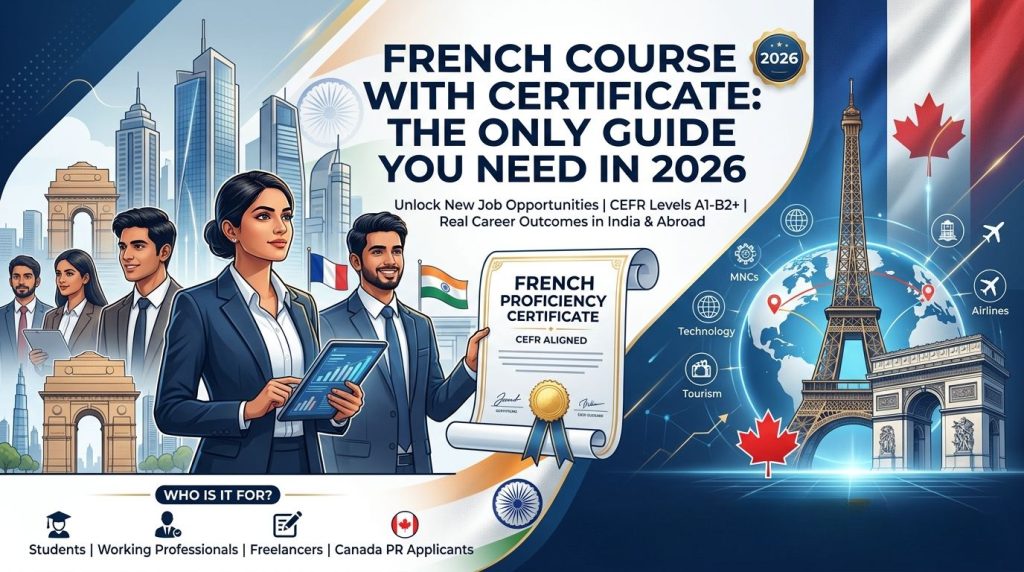
Students planning to study in France or Canada — French proficiency directly strengthens your application and visa eligibility.
Working professionals in BPO, tourism, export-import, or hospitality who want to move into higher-paying French-process or international roles.
Job seekers who want to stand apart in a market where most applicants look the same on paper.
Freelancers who want to add translation or language training services to their income streams.
Anyone with Canada PR plans — the TEF/TCF score required by Canadian immigration authorities is something you build toward through a proper French course.
What Makes a Good Online French Program The Short List
A course worth your time and money will have:
- CEFR-aligned levels from A1 to at least B2
- Live or recorded sessions with qualified trainers
- Dedicated speaking and listening practice (not just grammar drills)
- Regular assessments with feedback
- A certificate that names the level completed
- DELF/DALF preparation support at intermediate levels
- Access to study materials beyond the classroom
From Zero to Certificate: A Realistic Timeline
Here’s what six months of consistent effort actually looks like:
Month 1–2: A1 complete. You can introduce yourself, handle basic conversations, and read simple texts. The first certificate milestone is within reach.
Month 3–4: A2 complete. You can write simple emails, discuss daily life, and hold short conversations with French speakers. Entry-level job eligibility begins here.
Month 5–6: B1 underway. Professional communication is developing. You can begin targeting French-process roles and building a freelance profile.
Six months in: You have a verifiable certificate, real language skills, and a credential that most of your competitors don’t have. That’s the actual return on investment.
hy Learn French with Ankita Wadhwani? (Not Just Another Online Course)
Most French courses give you videos and a PDF certificate. That’s it.
French Classes by Ankita Wadhwani — based in Udaipur, operating online and offline worldwide — is built differently. Here’s what that actually looks like in practice.
The Instructor Behind the Course
Ankita Wadhwani is a certified French language instructor based in Udaipur, Rajasthan. She teaches students across all levels — from absolute beginners who have never seen a French word, to advanced speakers preparing for professional and academic goals.
Her focus is not just on grammar and vocabulary. It’s on making students confident, functional French communicators. That’s a different goal — and it produces different results.
What You Actually Get When You Enrol
Personalized Learning — Not a One-Size Batch
Every student comes in with a different starting point, a different goal, and a different pace. Ankita’s approach is built around that reality. Lessons are tailored to your level and your objectives — whether you’re preparing for a job interview, a Canada visa, or simply want to hold a conversation.
You’re not just a seat in a batch. Your progress is tracked individually.
Certified, Experienced Instruction
Ankita brings direct teaching experience across beginner to advanced CEFR levels. Students get structured guidance — not just recorded videos left to figure out on their own. Every session has a clear learning objective, and doubts are addressed in real time.
Online and Offline — Genuinely Flexible
Live online batches are available for students anywhere in the world. In-person classes are available for those in and around Udaipur. You’re not forced into one format — you choose what works for your schedule and location.
This is not a pre-recorded course you buy and forget. It’s live instruction with a real teacher.
Courses for All Levels — A1 to Advanced
Whether you’re starting from zero or picking up from where a previous course left off, there’s a structured path for you. Ankita teaches all CEFR levels, so you don’t have to switch providers as you progress. One instructor, one consistent teaching approach, all the way through.
Real Speaking Practice from Day One
Most students fear speaking more than anything else in language learning. Ankita’s classes put speaking at the centre — not at the end. From the first session, you practise real conversation, not just written exercises.
A Supportive Learning Community
Students who join French Classes by Ankita Wadhwani become part of a group of learners at similar stages. That peer environment — where you practise together and learn from each other — is something a solo app or a recorded course simply cannot replicate.
Who Joins These Classes?
Students across India and internationally enrol for different reasons:
- School and college students building French as a second language skill
- Working professionals targeting French-process roles or MNC positions
- Individuals planning Canada PR or France study applications
- Travelers who want functional French before a trip
- Freelancers building translation or tutoring capabilities
The common thread: they want proper instruction, not just content to consume passively.
Online French Classes Global Access, Personal Attention
One of the clearest advantages of Ankita’s program is that geography is not a barrier. Students from cities across India — and internationally — attend live sessions online and receive the same personalised instruction as in-person students.
You don’t need to be in Udaipur. You don’t need to be in a metro. You just need a device, an internet connection, and the decision to start.
View course details, batch schedules, and enrolment options at onlinefrenchclasses.in
FAQs: Straight Answers
Is a French certificate useful for getting jobs in India? Yes — particularly in French-process BPOs, MNC offices of French companies, travel and hospitality companies, and embassies. The certificate signals that you’ve completed structured training, not just casual exposure.
Can I learn French online and get a certificate? Yes. Multiple platforms offer certified online French courses in India. Look for NSDC-approved or CEFR-aligned programs for the strongest credential.
How long does it take to complete a French course? A1 takes 6–8 weeks at 1–2 hours per day. Full A1–B1 takes roughly 6–9 months with consistent study.
What is the fee range for French courses in India? Online programs range from ₹1,000 to ₹25,000 depending on the level and provider. Offline institute programs in metros typically run ₹20,000–₹60,000 for equivalent levels.
What is the difference between a DELF certificate and a course certificate? A course certificate confirms you completed a training program. A DELF certificate, issued by France Éducation International, is internationally recognised and accepted by universities, embassies, and Canadian immigration authorities.
Which is better — online or offline French learning? For most learners in India, online is more practical, more affordable, and often better-structured. Offline works well for those near major cities who specifically need classroom interaction.
Do I need prior knowledge of French to enrol? No. A1-level courses start from zero — alphabets, basic greetings, pronunciation, and foundational grammar are all covered from scratch.
Your Next Step
The demand for French-speaking professionals in India is outpacing the supply. That’s not a trend — it’s the current state of the market.
Six months from now, you could have a certificate, a new skill, and access to roles most people can’t qualify for. Or you could still be where you are today.
Seats fill fast. The right time is now.
External sources referenced: CEFR Language Levels – Council of Europe | DELF/DALF Official – CIEP | France Éducation Internationale